Barriers and Mindsets

Number of replies: 2
Instructions
Answer the three questions below by creating a reply (minimum 50 words)

Note: When you post to this forum, your full name will be displayed to other learners in this course. If you do not wish for other learners to see your name and response, please tick the 'reply privately' box before posting to the forum.

Questions
  • What is your language other than English (LOTE)?
  • What are some barriers that make it difficult for you to perform interactional management when working with this language?
  • What are some ways of thinking that can help you overcome these barriers?
In reply to First post

Barriers and Mindsets

by Umme Habiba Haque -

One barrier in interactional management is differences in communication style between Bangla and English, especially indirectness, politeness forms, and hesitation to interrupt, which can affect turn-taking and clarity. Another difficulty is limited vocabulary in specialised domains (medical/legal), which can slow interpretation and reduce confidence during fast exchanges.

To overcome these barriers, a solution-focused mindset is important: continuous terminology preparation, active exposure to formal registers, and practising structured turn-taking strategies. Developing metacognitive awareness (noticing when meaning is culturally implied rather than explicit) also helps. Additionally, maintaining neutrality while seeking clarification appropriately ensures accurate communication without overstepping the interpreter role.


In reply to First post

Barriers and Mindsets

by Sokla Heng -

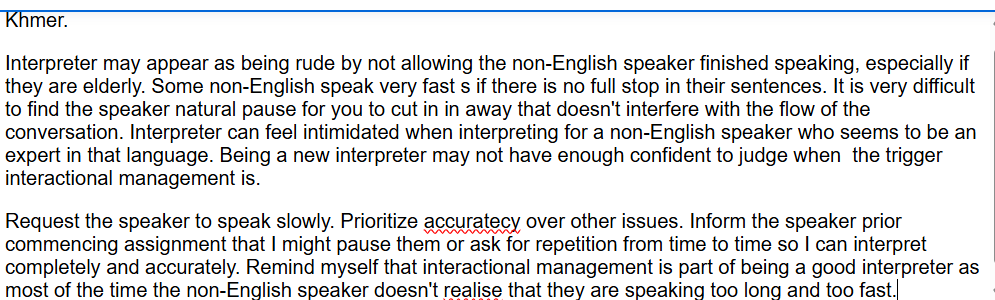
Khmer.

Interpreter may appear as being rude by not allowing the non-English speaker finished speaking, especially if they are elderly. Some non-English speak very fast s if there is no full stop in their sentences. It is very difficult to find the speaker natural pause for you to cut in in away that doesn't interfere with the flow of the conversation. Interpreter can feel intimidated when interpreting for a non-English speaker who seems to be an expert in that language. Being a new interpreter may not have enough confident to judge when  the trigger interactional management is.

Request the speaker to speak slowly. Prioritize accuratecy over other issues. Inform the speaker prior commencing assignment that I might pause them or ask for repetition from time to time so I can interpret completely and accurately. Remind myself that interactional management is part of being a good interpreter as most of the time the non-English speaker doesn't realise that they are speaking too long and too fast.

Attachment Sokla-answers.png